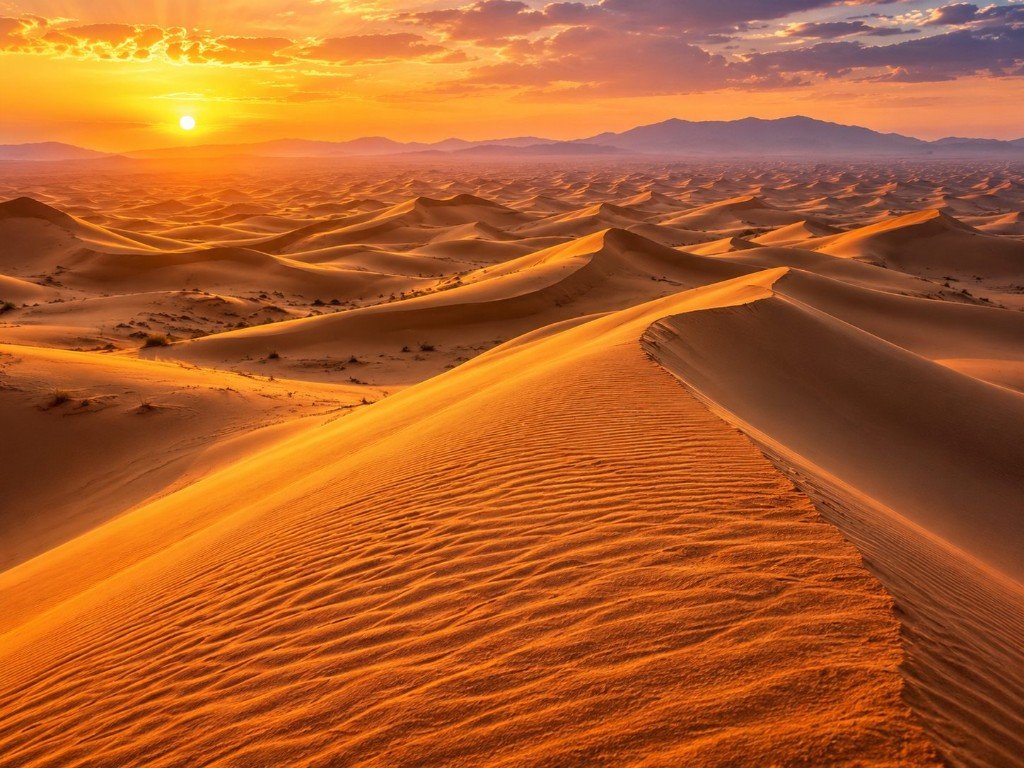
 60 pieces · Nature
PuzzleBeat
Desert dunes Jigsaw Puzzle — Play Free Online
Rolling sand and warm light — a minimalist landscape that stays fun from the first piece to the last. Pick your difficulty and beat your best time.
This nature jigsaw runs entirely in your browser. Choose difficulty on the play screen, use the optional timer to race your best score, or upload a personal photo for a custom puzzle anytime.
No download, no account — just tap play and start placing shaped pieces on the board.
About this puzzle
A dune is a pile of sand the wind can still move. Grains saltate — they hop — until they hit a slip face and avalanche at roughly 32–34 degrees, the angle of repose for dry sand. That number is why dune photographs look so geometric: a sharp crest, a steep downwind face, a gentler windward slope packed by impacts. Barchan dunes are crescents that march with the horns pointing downwind. Longitudinal (seif) dunes run as long ridges where winds have two seasons. Star dunes grow where winds arrive from many directions and the sand has nowhere to escape, piling into pyramids you can see in the Sahara and in Death Valley’s smaller fields. This PuzzleBeat desert scene is that wind architecture, not a beige texture pack.
Earth’s great sand seas are not empty. The Sahara’s ergs, the Namib’s coastal dunes that run almost into the Atlantic, the Rub’ al Khali (Empty Quarter) on the Arabian Peninsula, and China’s Taklamakan all have their own color because the sand’s mineralogy differs — iron-stained oranges, pale quartz, even gypsum white at White Sands in New Mexico. North America’s Great Sand Dunes in Colorado sit against the Sangre de Cristo range; the contrast of alpine snow and a dune field in one frame is a real place, not a collage. The Namib’s Sossusvlei clay pans and dead camel thorn trees are among the most photographed dune-adjacent scenes on Earth because the red sand against white clay is a ready-made composition.
Wind is the sculptor and the clock. Dunes migrate; a barchan can bury a road in years. Ripples on the surface are a smaller wavelength of the same physics, which is why a close-up dune photo is a fractal of the large form. At dawn and dusk the low sun turns every ripple into a line of highlight and shadow — the exact feature that makes a dunes jigsaw possible. Midday sand is a single value and a miserable sort. If this image is golden-hour, thank the photographer; they gave you edges.
Deserts are not lifeless. Sidewinders, beetles that stand on their heads to drink fog in the Namib, fox tracks on a morning slip face, and sparse shrubs that nucleate embryonic dunes all show up as tiny anomalies in a sea of repeating curves. Those anomalies are your rare pieces. So is any human trace: a single set of footprints is both a compositional gift and a reminder that dunes record the last walk until the next wind.
People misread dunes as empty recreation. They are also water catchments at their edges, grazing conflict zones, and in some countries, oil and military space. Sand mining and off-road traffic destroy the crusts that stabilize some fields. Photographers and jigsaw solvers meet the pretty version: a crest against a hard sky. The physics underneath is the same saltation that fills your shoes on a beach, scaled up until it is a mountain of quartz.
Grain size and moisture change everything you see. Fine gypsum at White Sands is almost blinding; coarse quartz looks darker when wet after a rare desert rain, which is why some dune photos have a two-tone slip face. Windward faces can be firm enough to walk; leeward faces collapse under a boot — photographers learn that the hard way. Crescent barchans on a dark desert pavement (reg) give you a second color family besides sand, which this jigsaw will use if the photo includes any stone floor.
On the PuzzleBeat board, desert dunes are a curve sort. Follow a slip-face shadow as if it were a road. Separate sky (usually a simple gradient) from sand (the whole problem). Ripple frequency changes with distance; near-field ripples are sharper. There is no city grid to cheat with. Play free in the browser, pick a moderate piece count unless you enjoy nearly identical ochre tiles, and use preview when two crests swap in your pile. The photograph is the subject — real aeolian landforms, not a drawn pyramid.
How to play
- Tap Play Desert dunes puzzle to open the puzzle board, then choose your piece count and difficulty.
- Drag pieces from the tray onto the board and snap them into place until the full image is complete. Works with mouse on desktop and touch on mobile.
- Use the Preview button on the play screen to peek at the full reference image whenever you need a hint.
- When you finish, check your solve time on the completion screen and share it with friends to see who can beat your record.
Frequently asked questions
- How do sand dunes actually form?
- Wind lifts loose sand; grains hop (saltation) and stop where the air slows. The pile grows a slip face that avalanches at about 32–34 degrees. Shape depends on whether wind is one-way (barchans) or many-way (star dunes).
- Is this desert the Sahara, Namib, or somewhere else?
- The landing is a desert-dune photograph of that landform class. Color and ripple scale vary by mineralogy and wind. The jigsaw difficulty is the repeating sand, not a labeled GPS pin.
- Why are dune puzzles harder at noon-looking light?
- Without long shadows, sand is one value. Golden-hour crests give you dark slip faces to bin. If the photo is flat, sort sky first and hunt any vegetation or footprint.
- Can I play the desert dunes jigsaw free on PuzzleBeat?
- Yes. Browser pieces, no account. Upload your own dune photo from the play page if you hiked a field and want that exact crest.