 24 pieces · Space
PuzzleBeat
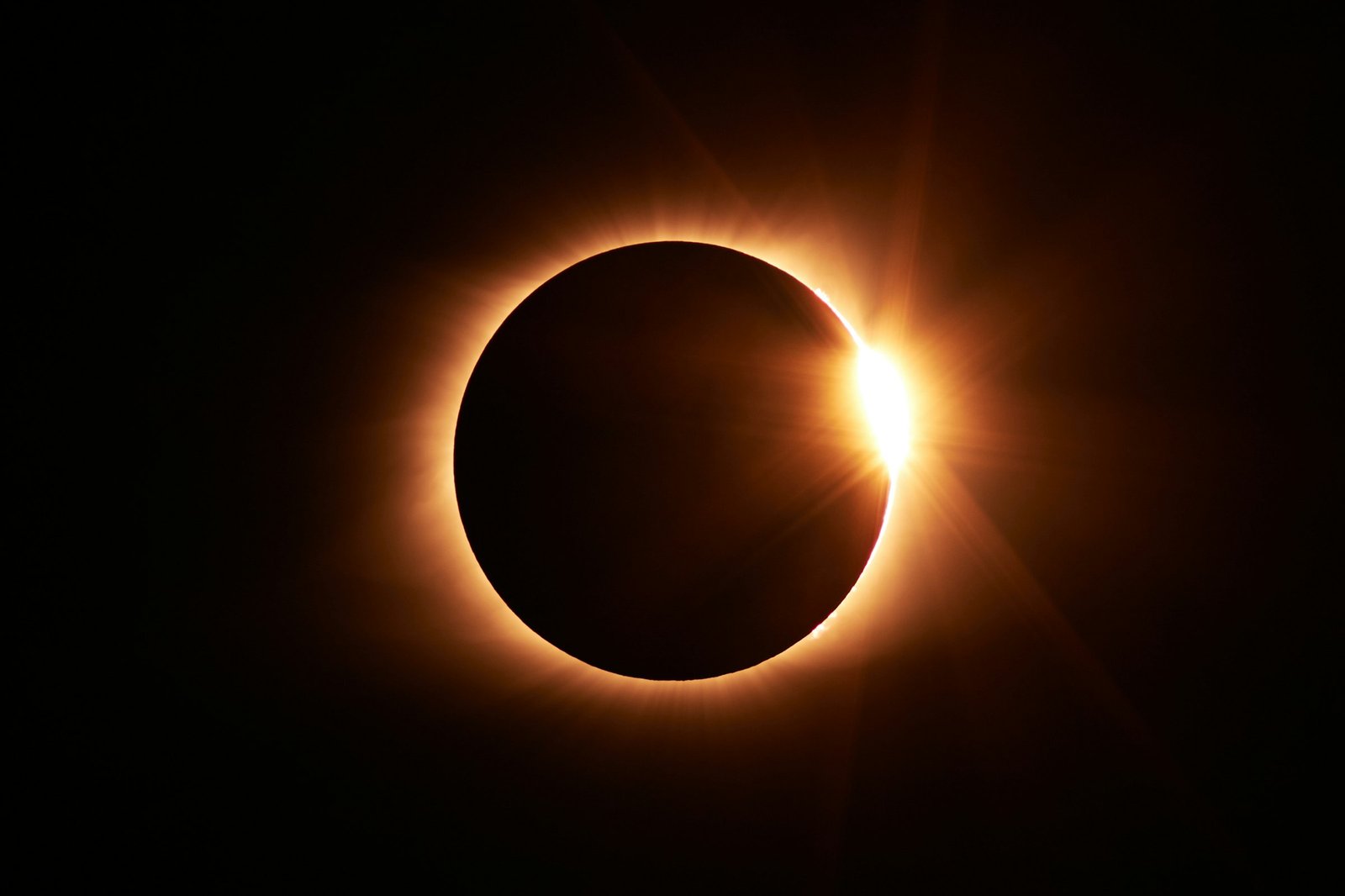
Eclipse Diamond Ring
Enjoy this space scene as a free online jigsaw. Pick your piece count and start solving in your browser.
This space jigsaw runs entirely in your browser. Choose difficulty on the play screen, use the optional timer to race your best score, or upload a personal photo for a custom puzzle anytime.
No download, no account — just tap play and start placing shaped pieces on the board.
Eclipse Diamond Ring
Just before a total solar eclipse begins — and again as it ends — a single bead of sunlight slips past a valley on the Moon's edge. For a breath, that point of light sits on a thin ring of the solar corona: the diamond ring. It is not a trick of the camera. It is geometry and time, the last (or first) photosphere gleaming against a darkened sky while the corona already glows like a halo.
On August 12, 2026, a total solar eclipse will draw that path across Greenland, Iceland, and northern Spain. Along the narrow track of totality, the diamond ring will flash at second contact and again at third — a calm, brief spark before the world goes quiet, then a welcome return of day. The same night, the Perseid meteor shower reaches its peak under a new Moon, so the sky after sunset can hold both the memory of the eclipse and a scatter of meteors.
Certified eclipse glasses belong on for the partial phases; the diamond ring itself is the instant totality arrives or departs. This free Space jigsaw on PuzzleBeat rebuilds that moment of light. Piece together Eclipse Diamond Ring at your own pace — choose your piece count and play instantly in your browser with no download or account required.
How to play
- Tap Play Eclipse Diamond Ring puzzle to open the puzzle board, then choose your piece count and difficulty.
- Drag pieces from the tray onto the board and snap them into place until the full image is complete. Works with mouse on desktop and touch on mobile.
- Use the Preview button on the play screen to peek at the full reference image whenever you need a hint.
- When you finish, check your solve time on the completion screen and share it with friends to see who can beat your record.
Frequently asked questions
- What causes the diamond ring effect?
- The diamond ring appears when a last (or first) sliver of the Sun's bright surface shines through a low point on the Moon's limb while the corona already forms a ring. The contrast of that brilliant point against the dark lunar disk is what looks like a diamond on a band.
- When and where is the August 12, 2026 eclipse visible?
- Totality on August 12, 2026 crosses parts of Greenland, Iceland, and northern Spain (with a sliver of Portugal). A much wider region of Europe, Canada, and parts of the northern United States will see a partial eclipse the same day. Greatest totality lasts a little over two minutes near the Denmark Strait.
- What is the difference between a total and a partial eclipse?
- In a total solar eclipse, the Moon fully covers the Sun's bright disk along a narrow path, revealing the corona and the diamond-ring moments at the start and end of totality. A partial eclipse leaves a crescent of photosphere visible the whole time — striking, but without totality's dark sky or corona.
- How do I view a solar eclipse safely?
- Use certified eclipse glasses (ISO 12312-2) or a proper solar filter for every partial phase. Only during totality, when the Sun is fully covered, is it safe to look without them — and glasses go back on the instant any bright sunlight returns.