 96 pieces · Nature
PuzzleBeat
Misty forest Jigsaw Puzzle — Play Free Online
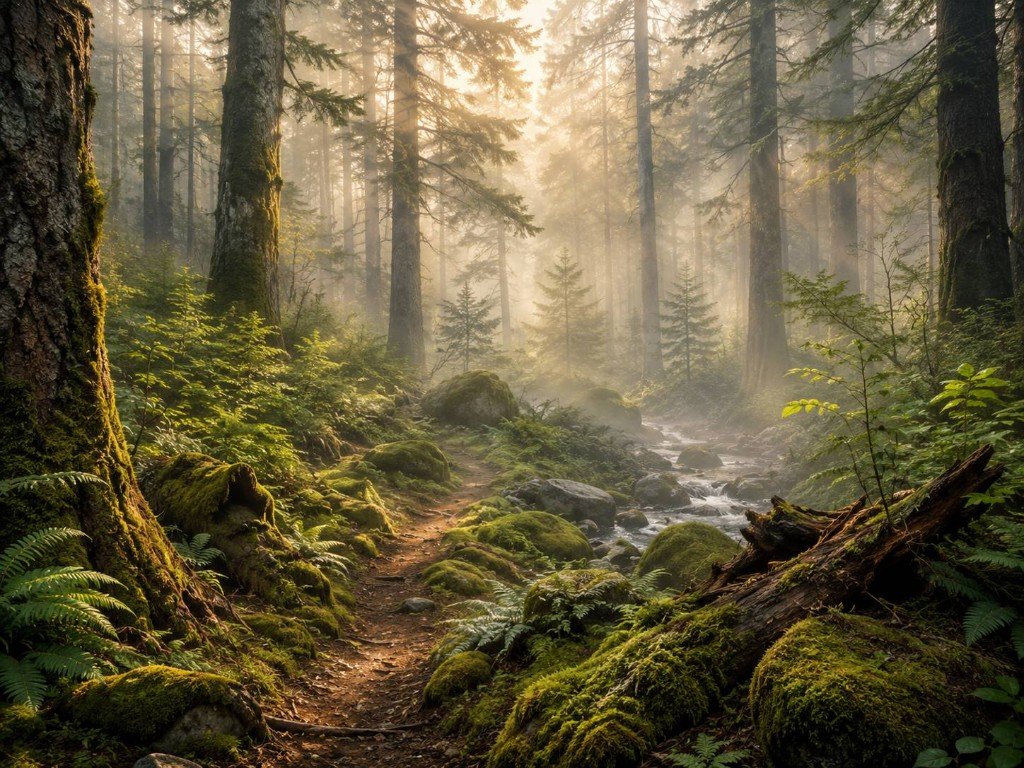
Soft fog between pine trunks gives this forest puzzle a peaceful mood. Great for a short break or a longer session when you crank up the piece count.
This nature jigsaw runs entirely in your browser. Choose difficulty on the play screen, use the optional timer to race your best score, or upload a personal photo for a custom puzzle anytime.
No download, no account — just tap play and start placing shaped pieces on the board.
About this puzzle
Mist in a forest is not smoke and it is not rain. It is air that has cooled to its dew point among trees, so water vapor condenses into droplets small enough to hang. Radiation fog forms on still nights when the ground loses heat and the valley floor fills like a lake; hikers meet it at dawn as a silver lid that burns off from the canopy down. Advection fog slides in when moist air moves over colder ground or a cold current — the Pacific Northwest specialty, where marine air meets the Olympic and Cascade forests. Cloud forests on tropical mountains are different again: the cloud is the climate, and epiphytes live in a permanent wet blur. This PuzzleBeat scene is that suspended-water look, the one that turns trunks into columns and depth into layers.
Temperate rainforests along Washington, Oregon, and British Columbia’s coasts are famous for this mood because rainfall measured in metres per year keeps the understory soaked. Sitka spruce, western hemlock, and Douglas fir hold moss that can weigh more than the branch when wet. Nurse logs grow new trees. The Hoh and Quinault valleys on the Olympic Peninsula are textbook: Roosevelt elk in the bottoms, banana slugs on the trail, and fog that makes a 50-metre tree look like it has no crown. Japan’s cedar and cypress groves, Central European beech woods after a warm front, and Appalachian cove forests after a summer storm all produce a cousin of the same light — diffuse, almost shadowless, with trunks as the only hard verticals.
Acoustically and optically, mist changes the forest. Sound muffles; birds sound closer than they are. Light has no single source, which is why photographs look painterly and why a jigsaw of this subject is cruel in a specific way: hundreds of pieces are “grey-green with a vertical.” The tell is bark texture, a fern’s bright new crozier, a trail ribbon, or the warmer tone of dead wood. Photographers wait for the five minutes when a shaft of sun hits the fog and you see volumetric rays. If this image has that shaft, it is your best unique cluster on the board.
Ecologically, fog is a water subsidy. In redwood country, trees take fog drip on needles when summer rain does not come. In tropical montane forests, the cloud belt is why those slopes stay wet while the lowland is seasonal. Climate shifts that raise the cloud base threaten those systems — a real conservation fact, not a slogan. Moss, liverworts, and lichens are the visible census of how often the air is saturated. When you sort this puzzle, the yellow-green of lichen versus the blue-green of wet needle foliage is a legitimate split.
People walk these woods for the same reason the photograph exists: the feeling of being inside weather rather than under a sky. Trail builders fight mud and blowdown. Search-and-rescue teams treat fog as a navigation hazard because ridgelines disappear. That human scale — a path, a boardwalk over a bog, a cedar stump — is often the only rectangular object in the frame. If this landing’s photo includes a trail, build it early; it is a road through otherwise repeating trunks.
Old-growth versus second-growth also changes the photograph. Old trunks are buttressed, broken, and mossed in plates; plantation rows are too regular for this mood. Blowdown after a windstorm opens a hole of bright fog. Seasonal phenology matters: deciduous mist in November is brown architecture; June mist is chlorophyll. If this image still has leaves, you are not looking at a bare Appalachian ridge in January — another reason two “foggy woods” puzzles are not duplicates.
On PuzzleBeat the misty forest jigsaw is a vertical sort. Separate canopy glow from mid-trunk from dark understory. Do not chase every similar needle cluster. Use preview when two firs become interchangeable. The piece engine is the same as every other catalog puzzle; the difficulty is the meteorology in the photograph. Play free in the browser, no account, and pick a smaller grid if you want the mood without a long fog-sorting session.
How to play
- Tap Play Misty forest puzzle to open the puzzle board, then choose your piece count and difficulty.
- Drag pieces from the tray onto the board and snap them into place until the full image is complete. Works with mouse on desktop and touch on mobile.
- Use the Preview button on the play screen to peek at the full reference image whenever you need a hint.
- When you finish, check your solve time on the completion screen and share it with friends to see who can beat your record.
Frequently asked questions
- Why is a forest misty at dawn but clear by noon?
- Overnight cooling drops air to the dew point. After sunrise the ground and canopy warm, droplets evaporate, and mixing pulls drier air in. Valley fog often drains or burns off from the top.
- Is this the same as a tropical cloud forest?
- Related idea, different climate. Cloud forests sit inside persistent mountain cloud. Temperate misty woods are often radiation or marine fog on a wet forest. Both photograph as layered trunks in grey light.
- How do I sort so many similar tree pieces?
- Bin by value (bright fog versus dark trunk) and by bark, not by “green.” Find any trail, fern, or sun shaft first — those are the rare unique tiles.
- Is the misty forest puzzle a real woodland photograph?
- Yes. PuzzleBeat uses a real forest scene. The softness is weather in the photo, not a blur filter on the jigsaw.