 60 pieces · Travel
PuzzleBeat
Rocky coast Jigsaw Puzzle — Play Free Online
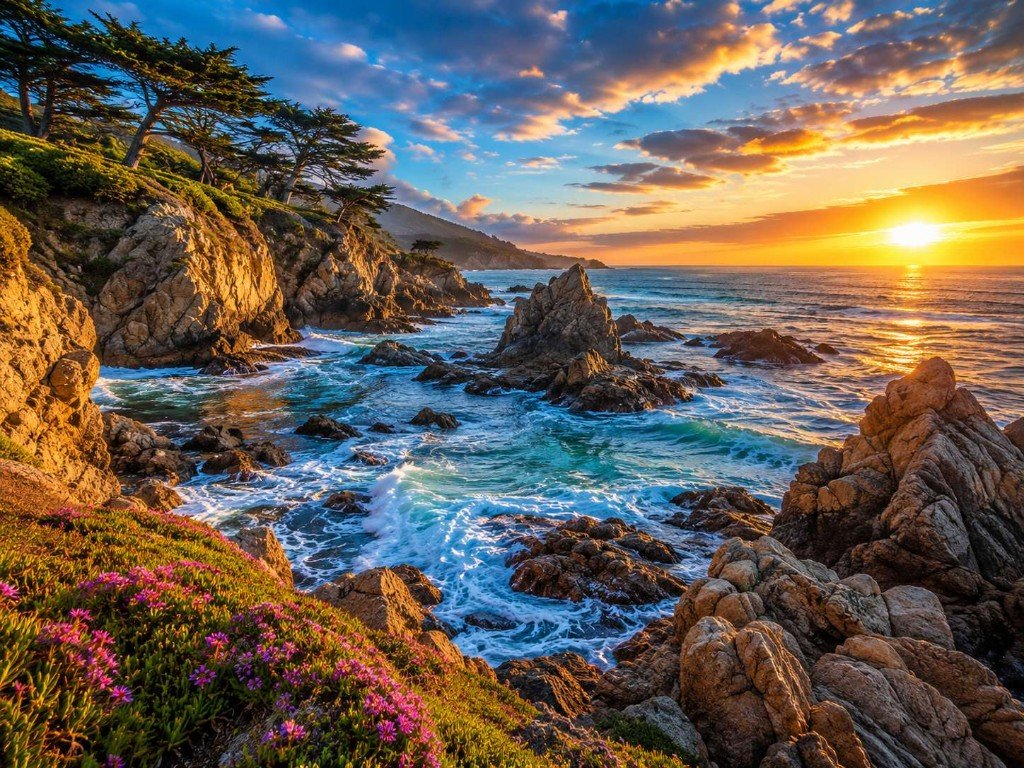
Sea spray, weathered rock, and deep blues — this coastal scene is built for relaxed solving or a timed run. Open it in one tap and play on phone or desktop.
This travel jigsaw runs entirely in your browser. Choose difficulty on the play screen, use the optional timer to race your best score, or upload a personal photo for a custom puzzle anytime.
No download, no account — just tap play and start placing shaped pieces on the board.
About this puzzle
A rocky coast is not a sandy beach with extra stones. It is the shoreline where resistant bedrock — basalt, granite, limestone, or folded metamorphic rock — meets open fetch and refuses to become a gentle strand. Waves do not politely lap; they hydraulic-jack joints, pluck blocks, and throw gravel at the cliff face until a wave-cut platform appears at low tide like a wet pavement. Sea stacks are the leftovers of those headlands: the Twelve Apostles along Victoria’s Great Ocean Road, Haystack Rock on the Oregon coast, Old Harry Rocks on England’s Jurassic Coast, and countless unnamed needles that last a few centuries before a winter storm finishes them. The photograph on this PuzzleBeat landing is that meeting of water and stone, not a generic “ocean vibe.”
Intertidal zonation is why rocky shores look striped if you know how to look. Highest up, periwinkles and lichens take spray. Below, barnacles and mussels lock onto the rock in densities that would look industrial if they were not alive. Lower still, seaweeds — rockweed, kelp holdfasts, coralline crusts — take the hours of submersion. Tide pools in the platform catch starfish, anemones, and sculpins that wait out low tide in a shrinking bath that can heat or freshen with rain. A six-hour tide cycle redraws that map twice a day. That is why a rocky-coast jigsaw has so many small color families: wet rock is not dry rock, and foam is not the same white as a gull.
Fetch and geology decide which coast you get. Oregon and Washington take Pacific swell that has traveled thousands of kilometres; winter storms there move logs like matchsticks and rearrange pocket beaches overnight. Cornwall and Brittany take Atlantic weather on palaeozoic rock, with drowned river valleys (rias) cutting inland. Portugal’s Algarve mixes limestone arches with tourist paths that close when rockfall is likely. Australia’s Great Ocean Road is younger volcanic and sedimentary rock being cut fast in geological terms — stacks collapse in living memory. Mediterranean rocky coasts are often steeper and less kelp-dominated because the tidal range is small. If you have stood on any of those, the puzzle’s palette will feel specific: cold green-grey Pacific, tea-colored Atlantic peat water, or bright limestone against cobalt.
Life on the cliff is as diagnostic as the rock. Common murres and guillemots pack ledges. Black oystercatchers work the mussels. Harbor seals haul on isolated rocks that boats cannot easily approach. In the Pacific Northwest, ochre sea stars and urchins structure kelp forests; sea-star wasting disease in the 2010s showed how fast that food web can shift. On Atlantic shores, limpets graze algae in home scars they return to. None of that is filler for a jigsaw — it is why the image has dark commas of birds, pale guano streaks, and the almost-black of wet basalt next to the pale of dried salt.
People use rocky coasts hard: lighthouses on the highest stack-adjacent headland, coast paths that fail after a slide, fisheries for lobster and crab in the kelp, and increasingly, managed-retreat arguments when a road sits on a slumping till cliff. Photographers chase the moment after a wave hits a stack and the spray hangs. That is also the hardest band of pieces on this board: white water against dark stone, with no unique object in every tile.
Winter storm seasons are the real clock. A single “bomb cyclone” on the Pacific can remove metres of cliff-top path and rearrange boulder beaches overnight; Atlantic gales do the same to Cornish coves. Geologists date raised platforms as fossil sea levels. Conservation fights are specific: climbing bans on nesting stacks, harvest limits on intertidal species, and armouring debates when a road sits on till. Those uses — path, lighthouse, fishery — sometimes appear as a tiny human rectangle in an otherwise geologic frame, which is a gift on a jigsaw.
Solving this rocky coast jigsaw on PuzzleBeat is a geology sort. Pull the foam line and the horizon first. Separate dry-bright rock from wet-dark rock. Bird specks and tide-pool color are your rare unique tiles. The catalog scene is a travel photograph with shaped browser pieces — not a cartoon cove — so similar greys are the real difficulty. Preview when two platforms look interchangeable. There is no account and no download; the grid size is how long you want to sit with the fetch.
How to play
- Tap Play Rocky coast puzzle to open the puzzle board, then choose your piece count and difficulty.
- Drag pieces from the tray onto the board and snap them into place until the full image is complete. Works with mouse on desktop and touch on mobile.
- Use the Preview button on the play screen to peek at the full reference image whenever you need a hint.
- When you finish, check your solve time on the completion screen and share it with friends to see who can beat your record.
Frequently asked questions
- What makes a coast “rocky” instead of a beach?
- Resistant bedrock and strong wave energy. Sand beaches form where sediment can accumulate; rocky coasts are where the rock outlasts the storm and leaves cliffs, platforms, and stacks.
- Are sea stacks like Haystack Rock or the Twelve Apostles the same landform?
- Yes in type: isolated pillars left after a headland erodes. They differ in rock and in how fast they fail. Several Apostles have collapsed in the last century; Haystack is a basalt remnant on a wide Oregon beach.
- Why is the waterline so hard to assemble in this puzzle?
- Foam, wet stone, and reflected sky share pale values. Sort by the hard cliff edge and any kelp or bird, then fill the spray. Preview is meant for that band.
- Is this rocky coast jigsaw a real shoreline or an illustration?
- It is a photograph of a real rocky shore class of landscape. PuzzleBeat does not cartoon the scene; difficulty is the photo’s own texture.